Spoiler alert: Everyone has been teachng about the 80/20 rule for longer than I’ve been alive, and that’s a long time.
It is helpful, in a way, but there’s a lot of variables and shouldn’t be taken as gospel.
At the end of this article I’ll give you access to a custom GPT that will let you get more benefit from this “rule” in YOUR OWN business. But first, let’s talk…
The 80/20 Rule Isn’t Really a Rule
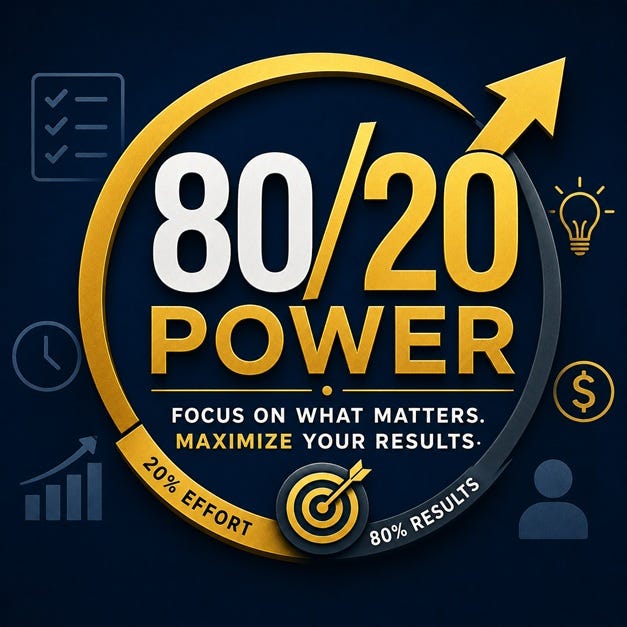
The 80/20 rule is commonly associated with the Pareto principle: the observation that, in many situations, a relatively small share of inputs can account for a disproportionately large share of outcomes.
In marketing, people often use “80/20” as shorthand.
It doesn’t mean exactly 20% of your emails will generate exactly 80% of your revenue, or that precisely 80% of your social posts are destined to accomplish very little.
Reality is messier than that.
The useful idea is simply this:
Your marketing inputs and outcomes are rarely distributed evenly.
Some customers will be dramatically more valuable than others.
Some traffic sources will outperform others.
Some topics will attract more attention.
Some headlines will generate far more clicks.
Some offers will convert better.
And occasionally, one piece of content will outperform dozens of things you spent just as much time creating.
Marketers have always known this intuitively.
The problem is that discovering the winners has historically been expensive.
Every experiment required time.
Every article had to be written.
Every email needed a subject line.
Every promotion needed creative.
Every new idea competed for your limited attention.
For a solo operator, the cost of finding the successful 20% could be enormous.
AI can reduce that cost.
AI Makes the Search for Winners Cheaper
Imagine you want to publish an article.
Traditionally, you might spend an hour researching the topic, another hour organizing your ideas, several hours writing, and additional time editing, formatting, and promoting it.
That makes experimentation expensive.
If the article goes nowhere, you haven’t simply learned that the topic failed to resonate. You may have sacrificed most of a working day to obtain that information.
Now consider an AI-assisted workflow.
You can use AI to explore possible angles before committing to one.
You can analyze customer questions and comments for recurring themes.
You can generate alternative headline concepts.
You can identify objections that should be addressed.
You can turn rough notes into an initial structure.
You can challenge your argument before publishing.
You can develop variations for different platforms.
The human still makes the important decisions.
But the cost of getting from idea to experiment can fall dramatically.
And that changes what is possible.
Instead of betting four hours on one idea, you may be able to investigate several ideas before deciding which deserves those four hours.
That distinction matters.
AI doesn’t have to make every piece of marketing better to be valuable.
Sometimes it simply needs to make learning cheaper.
Stop Asking AI to Produce More. Ask It to Help You Find More Winners.
This may be one of the biggest mistakes marketers make with generative AI.
They immediately focus on volume.
“How can I publish five articles instead of one?”
“How can I create 30 social posts?”
“How can I send more emails?”
“How can I fill every channel?”
Those questions sound productive.
But apply the 80/20 principle and you can see the danger.
If much of your marketing activity already produces relatively little value, automating the process could simply allow you to manufacture low-value marketing faster.
Congratulations. You’ve automated the 80%.
But wait…
Mistake #1: Using AI to Flood Every Channel
Being able to produce 100 posts doesn’t mean publishing 100 posts is a good strategy.
Volume can create its own costs: reviewing content, correcting errors, maintaining consistency, responding to engagement, monitoring platforms, and protecting your reputation.
Before automating a channel, ask whether that channel has already demonstrated value.
Scale evidence, not assumptions.
Mistake #2: Confusing AI Output With Customer Insight
An AI model can generate plausible customer objections.
Actual customers can tell you what their objections really are.
Those are not the same thing.
Use genuine customer conversations, comments, survey responses, reviews, support requests, analytics, and sales information whenever possible.
AI is excellent at helping organize and examine evidence.
It should not be used to fabricate evidence you don’t have.
Mistake #3: Automating Before You Understand What Works
Automation magnifies systems.
That’s wonderful when the system works.
It’s less wonderful when it doesn’t.
If your emails aren’t generating responses, automatically producing five times as many emails may not solve the underlying problem.
First identify what creates value.
Then automate or accelerate it.
Mistake #4: Removing Yourself From the Content
Solo creators have an advantage that large brands frequently struggle to reproduce: personality.
Your experience, opinions, examples, stories, taste, humor, and judgment are part of the product.
If AI makes your content sound indistinguishable from everybody else using the same tools, efficiency has come at a very high price.
Use AI to accelerate the mechanical parts.
Keep yourself in the parts people remember.
Mistake #5: Optimizing the Wrong 20%
Not every high-performing metric matters.
A controversial post might generate enormous engagement while attracting people who will never buy from you.
A click-heavy headline might produce weak subscriber retention.
A free resource might attract thousands of downloads but almost no customers.
The objective isn’t to identify the 20% that creates the most activity.
It’s to identify the 20% that contributes most to the outcome you actually want.
That difference is crucial.
The Real AI Advantage Is Leverage
There’s a popular assumption that the biggest advantage AI gives solo marketers is the ability to compete with larger teams.
There’s some truth to that.
But I think there’s a more interesting advantage.
AI allows small operators to become more selective.
When creating, testing, analyzing, and repurposing are expensive, you feel pressure to make every decision count.
That encourages caution.
AI lowers the cost of exploration.
You can investigate more ideas without fully committing to them.
You can test more variations.
You can analyze more feedback.
And when something works, you can extract far more value from it.
That doesn’t eliminate the 80/20 phenomenon.
It makes it less painful.
The unsuccessful experiments become cheaper lessons.
The successful experiments become more valuable assets.
And your scarce human attention can move toward the things machines are less capable of providing: judgment, taste, relationships, experience, positioning, and original ideas.
Don’t Try to Eliminate the 80%
This may be the counterintuitive lesson.
You probably shouldn’t try to eliminate the 80%.
Some degree of unsuccessful experimentation is the price of discovering what resonates.
Nobody knows with certainty which article will spread, which product will sell, which email will generate replies, or which idea will connect with an audience.
Marketing contains uncertainty.
AI doesn’t change that.
What it changes is the economics of operating under uncertainty.
If AI helps you explore ten promising ideas, reject seven before investing heavily, test three efficiently, identify one winner, analyze why it worked, and transform that winner into multiple valuable assets, then the technology has done something far more useful than simply “writing content.”
It has increased your leverage.
So perhaps the question for solo marketers isn’t:
How can AI help me create more?
A better question might be:
How can AI help me discover what deserves more of me?
That is where the 80/20 principle and AI become a powerful combination.
The 80% gives you information.
The 20% gives you direction.
And AI can help you move between the two faster than ever before.
Would you like a personalized 80/20 roadmap to increase results while reducing workload in YOUR business?
Well, if so, you’re in luck today because I’ve created a custom GPT that will interview you and do just that.