
Key Takeaway
Artificial intelligence has evolved from a speculative technology to the dominant force driving stock market performance in 2026. Companies leading the AI revolution have delivered extraordinary returns, with the AI sector outperforming broader indices by over 45% year-to-date. This transformation extends far beyond technology stocks, as AI adoption permeates healthcare, finance, manufacturing, and virtually every sector of the global economy.
For investors, understanding AI’s market impact has become essential rather than optional. The technology is fundamentally altering how businesses operate, compete, and create value. Companies that successfully integrate AI capabilities are gaining significant competitive advantages, while those lagging behind face existential threats. This dynamic is creating new winners and losers across the market, requiring investors to develop fresh analytical frameworks and investment strategies to navigate this rapidly evolving landscape.
The investment implications are profound. Traditional valuation metrics alone are insufficient when evaluating AI-focused companies, as the technology enables exponential rather than linear growth potential. Forward-thinking investors are positioning their portfolios to capture this secular trend while carefully managing the risks associated with heightened volatility and regulatory uncertainties that inevitably accompany transformative technologies.
Understanding AI’s Market Dominance in 2026
The AI Sector’s Explosive Growth
The artificial intelligence sector has cemented its position as the primary driver of equity market returns throughout 2026. Mega-cap technology companies with significant AI exposure now account for an unprecedented portion of major index movements, with NVIDIA, Microsoft, Alphabet, and Amazon collectively representing over 25% of the S&P 500’s market capitalization. This concentration reflects investor conviction that AI capabilities will determine corporate winners and losers over the coming decade.
Revenue growth within the AI infrastructure segment has been staggering. Data center spending on AI-specific hardware has grown by over 80% annually, driven by the insatiable demand for computational power required to train and deploy large language models. This spending boom has created a virtuous cycle, with chip manufacturers, cloud providers, and AI application companies all benefiting from unprecedented capital investment flows.
The market has rewarded this growth with premium valuations that would have seemed excessive just years ago. However, these valuations increasingly appear justified as AI adoption accelerates across enterprise customers. Companies are reporting measurable productivity gains, cost reductions, and revenue enhancements from AI implementation, transforming speculative hype into tangible financial results that support elevated stock prices.
Broader Market Implications
AI’s influence extends well beyond pure-play technology stocks. Traditional industries are experiencing profound disruption as AI capabilities enable new business models and threaten established competitive moats. Healthcare companies leveraging AI for drug discovery are compressing development timelines from years to months, while financial institutions using AI for risk assessment and trading are achieving superior returns with lower volatility.
This technology diffusion is creating investment opportunities across sector boundaries. Industrial companies implementing predictive maintenance through AI are seeing dramatically reduced downtime and maintenance costs. Retailers using AI for inventory optimization and personalized marketing are achieving higher margins and customer retention rates. Even commodity-driven sectors like energy are being transformed by AI-optimized exploration, production, and distribution processes.
The productivity implications are particularly significant for economic growth projections. Economists estimate that widespread AI adoption could boost global productivity growth by 1.5 to 2.5 percentage points annually over the next decade. This represents a potential doubling of trend productivity growth, which would have profound implications for corporate earnings, interest rates, and equity valuations across the entire market.
Top AI Stocks Leading the Revolution
NVIDIA: The AI Chip King
NVIDIA has solidified its position as the most critical infrastructure provider for the AI revolution. The company’s data center revenue has grown exponentially as cloud providers, enterprises, and startups rush to acquire graphics processing units for AI training and inference workloads. This dominant market position has translated into extraordinary financial performance and stock price appreciation.
The company’s competitive moat extends beyond hardware to encompass software ecosystems. CUDA, NVIDIA’s parallel computing platform, has become the industry standard for AI development, creating powerful network effects that make it increasingly difficult for competitors to gain significant market share. This software advantage compounds the hardware superiority, creating a formidable barrier to entry that protects NVIDIA’s premium pricing and margins.
Looking forward, NVIDIA continues to innovate aggressively, introducing new chip architectures that dramatically improve performance while reducing power consumption. The company’s expansion into networking, software, and services is transforming it from a component supplier into a comprehensive AI infrastructure provider. This evolution could support continued growth and market leadership even as competition intensifies from both traditional semiconductor companies and custom chip initiatives by major cloud providers.
Microsoft: Enterprise AI Integration
Microsoft has emerged as the leader in enterprise AI adoption through its strategic partnership with OpenAI and aggressive integration of AI capabilities across its product portfolio. Azure’s AI services revenue has grown by triple digits, positioning the company as the preferred cloud platform for AI development and deployment. This advantage reinforces Microsoft’s broader cloud computing leadership and creates significant cross-selling opportunities.
The integration of Copilot across Office 365, Dynamics, and other productivity tools represents a potentially transformative revenue opportunity. If even a fraction of Microsoft’s massive installed base adopts these AI-enhanced offerings at premium pricing, the revenue uplift could be measured in tens of billions of dollars annually. Early adoption metrics suggest strong customer interest, though sustained engagement and willingness to pay remain key variables to monitor.
Microsoft’s enterprise relationships and trust position the company uniquely to capture AI value across implementation cycles. Unlike consumer-focused AI applications that may face rapid commoditization, enterprise AI solutions require significant customization, integration, and ongoing support—areas where Microsoft’s comprehensive platform and service capabilities provide durable competitive advantages. This positions the company to capture value not just from AI technology itself, but from the complex implementation process that enterprises require.
Alphabet: AI-Powered Advertising and Cloud
Alphabet’s extensive AI research capabilities, developed over more than a decade, are now translating into significant commercial advantages. Google’s search algorithms have been enhanced with large language models, improving result relevance and maintaining the company’s dominant market position despite competitive threats. More importantly, AI is transforming Google’s advertising business through better targeting, creative optimization, and performance measurement.
Google Cloud has emerged as a strong competitor in the AI infrastructure market, leveraging the company’s proprietary tensor processing units and deep expertise in machine learning. The platform’s AI and machine learning services revenue has grown rapidly, attracting customers who want alternatives to NVIDIA-dependent solutions or who value Google’s specific technical capabilities. This diversification reduces Alphabet’s dependence on advertising while opening new growth vectors.
The company’s AI chatbot, Gemini, represents both an opportunity and a challenge. While competing directly with ChatGPT requires significant investment with uncertain returns, the technology enhances Google’s existing products and provides valuable training data and user feedback loops. The key question for investors is whether Alphabet can monetize these AI investments effectively while defending its core search and advertising franchises against disruptive threats.
Investment Strategies for the AI Era
Portfolio Allocation Considerations
The concentration of AI-related stocks within major indices creates both opportunities and risks for investors. While passive exposure to indices provides participation in AI leaders’ growth, it also concentrates portfolio risk in a relatively small number of highly correlated stocks. This concentration risk has become increasingly apparent as AI-related volatility drives broader market movements.
Active investors may consider targeted allocations to AI-focused ETFs or individual stocks to better control their exposure to this theme. However, stock selection within the AI space requires careful analysis of competitive positioning, valuation, and execution risk. Not all companies benefiting from AI enthusiasm will deliver sustained outperformance, and the sector’s high valuations leave little room for disappointment.
Diversification remains important even when investing in transformative technologies. While AI is undoubtedly significant, other factors—including interest rates, geopolitical developments, and macroeconomic conditions—continue to influence market performance. Maintaining exposure to non-AI sectors and asset classes provides important risk management benefits and may offer better value opportunities in a market where AI stocks trade at substantial premiums.
Risk Management in a High-Volatility Sector
AI stocks have demonstrated significantly higher volatility than the broader market, with sharp price movements driven by product announcements, earnings results, competitive developments, and shifting sentiment. This volatility creates both opportunities for active traders and risks for long-term investors who may be forced to sell during temporary downturns.
Position sizing should reflect this elevated risk profile. Concentrated positions in individual AI stocks can generate extraordinary returns but also carry the potential for substantial losses. Investors should carefully consider their risk tolerance, investment horizon, and overall portfolio context when determining allocation to this volatile sector.
Regulatory risk represents an additional consideration that may not be fully reflected in current valuations. Governments worldwide are developing AI governance frameworks that could impose significant compliance costs, restrict certain applications, or even mandate structural separations of AI businesses from other operations. While regulatory clarity may ultimately benefit established players by creating barriers to entry, the transition period could create significant uncertainty and valuation pressure.
For investors seeking exposure to AI growth with potentially lower volatility, consider exploring Intellectia.AI’s AI-powered stock screener to identify diversified opportunities across the AI value chain.
Sector-Specific AI Investment Opportunities
Healthcare: AI-Enabled Drug Discovery
The pharmaceutical industry is experiencing a productivity renaissance driven by AI-powered drug discovery platforms. Machine learning algorithms can now predict molecular properties, identify promising drug candidates, and optimize clinical trial designs with unprecedented accuracy. These capabilities are compressing development timelines from the traditional 10-15 years to potentially 5-7 years for certain therapeutic categories.
Companies at the forefront of this transformation include both established pharmaceutical giants with significant AI investments and specialized biotech firms built around AI-native discovery platforms. The investment thesis for these companies rests on the potential for dramatically improved success rates in drug development, which has historically been plagued by high failure rates and enormous costs.
Beyond drug discovery, AI is transforming medical imaging, diagnostics, and personalized treatment recommendations. Radiology companies incorporating AI algorithms are achieving diagnostic accuracy that matches or exceeds human specialists while dramatically reducing analysis time. These applications create opportunities for both healthcare providers and technology companies developing AI-enabled medical devices and software.
Financial Services: Algorithmic Edge
The financial sector has been an early and aggressive adopter of AI technologies, using machine learning for everything from fraud detection to algorithmic trading. Banks and payment processors are achieving significant cost savings through AI-powered automation of customer service, compliance monitoring, and back-office operations. These efficiency gains are translating into improved profitability and competitive positioning.
Asset managers are increasingly relying on AI for investment research, risk management, and portfolio construction. Quantitative strategies that incorporate machine learning are capturing market share from traditional fundamental approaches, though the competitive advantage may diminish as these techniques become more widely adopted. The key differentiator is increasingly the quality and uniqueness of data inputs rather than the algorithms themselves.
Fintech companies are leveraging AI to create more personalized financial products and services. Robo-advisors using sophisticated algorithms can provide customized investment advice at a fraction of the cost of human advisors. Lending platforms employing AI for credit assessment can serve customers overlooked by traditional scoring models while maintaining appropriate risk standards. These innovations are democratizing access to financial services while creating significant market opportunities.
Autonomous Vehicles and Transportation
While fully autonomous vehicles remain elusive, AI is transforming transportation through incremental advances in driver assistance systems, logistics optimization, and predictive maintenance. Companies leading in these areas are achieving measurable improvements in safety, efficiency, and cost reduction that translate into competitive advantages and investment returns.
The path to full autonomy remains uncertain, with technical challenges, regulatory hurdles, and liability questions yet to be fully resolved. However, the intermediate applications of AI in transportation are already creating substantial value. Fleet operators using AI for route optimization are achieving significant fuel savings and productivity improvements. Manufacturers employing predictive maintenance are reducing downtime and extending vehicle lifespans.
Investment opportunities extend across the transportation ecosystem, from semiconductor companies providing AI chips for vehicle systems to software companies developing autonomous driving algorithms to traditional automakers successfully integrating AI capabilities. The winners in this transformation may not be the companies most often discussed in the media, but rather those successfully applying AI to solve practical transportation problems.
Valuation Challenges in the AI Boom
Traditional Metrics Under Pressure
Conventional valuation approaches face significant challenges when applied to AI-focused companies experiencing exponential growth. Price-to-earnings ratios that would appear excessive for mature companies may be justified by the potential for rapid revenue expansion and margin expansion as AI businesses scale. However, distinguishing between genuine growth opportunities and speculative bubbles requires careful analysis.
Free cash flow metrics may understate the value of AI companies making heavy investments in research and development, data infrastructure, and talent acquisition. These investments appear as expenses on income statements but may create durable competitive advantages that generate returns for years to come. Investors must assess whether current investments are building genuine capabilities or merely consuming capital without commensurate benefits.
Comparative valuation approaches are complicated by the unique nature of AI businesses. Few historical precedents exist for companies with the growth trajectories, margin profiles, and competitive dynamics of leading AI firms. This uncertainty creates wide valuation ranges and significant volatility as market participants debate appropriate pricing for these unprecedented business models.
Assessing Competitive Moats
Sustainable competitive advantage is crucial for justifying premium valuations, yet assessing moats in rapidly evolving AI markets is exceptionally challenging. Data advantages, network effects, and technical capabilities that provide leadership today may be quickly eroded by competitors’ innovations or shifts in technology paradigms.
Investors should evaluate whether AI companies possess genuine differentiation or are merely benefiting from temporary market enthusiasm. Sustainable advantages typically include proprietary data assets that improve with scale, ecosystem lock-in that makes switching costly for customers, and organizational capabilities that enable rapid innovation and execution.
The concentration of AI talent represents both an opportunity and a risk for investors. Companies with exceptional technical teams may maintain competitive advantages through continued innovation, but talent is mobile and key individuals leaving can significantly impact competitive positioning. Understanding organizational culture, incentive structures, and talent retention is essential for assessing the durability of AI competitive advantages.
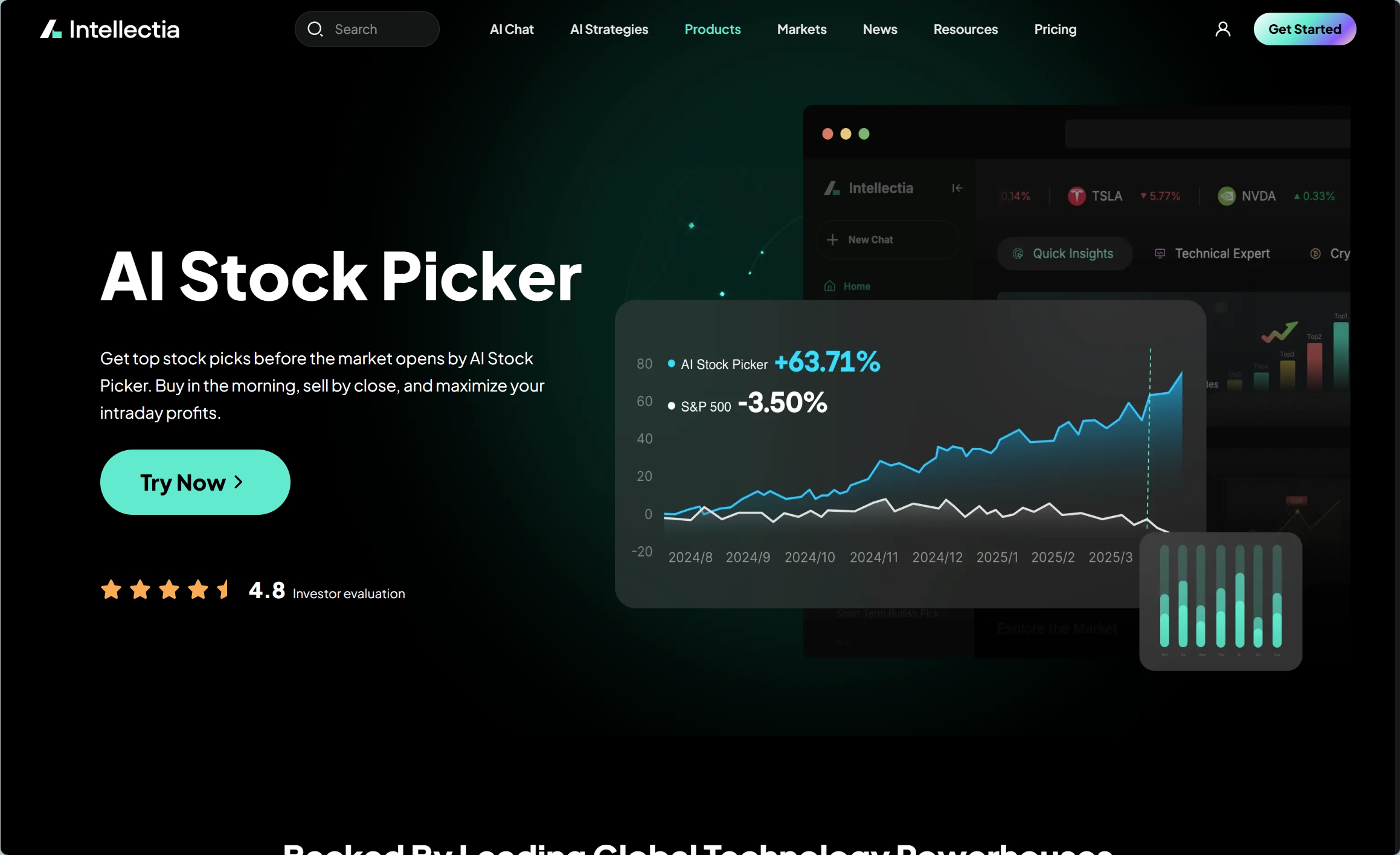
To identify AI stocks with sustainable competitive positions, try Intellectia.AI’s AI stock picker for data-driven analysis and recommendations.
Global AI Competition and Geopolitics
The US-China AI Rivalry
Artificial intelligence has emerged as a central battlefield in the technological competition between the United States and China. Both countries recognize AI’s strategic importance for economic competitiveness, military capabilities, and global influence. This rivalry has significant implications for investors in AI-related companies on both sides of the Pacific.
US export controls on advanced semiconductors to China have disrupted supply chains and forced Chinese companies to accelerate domestic development of AI capabilities. While these restrictions may slow Chinese AI progress in the near term, they are also catalyzing massive investment in indigenous semiconductor and AI industries. Long-term investors must consider whether current competitive advantages for US companies will persist or whether Chinese competitors will eventually close the gap.
The bifurcation of AI ecosystems creates both risks and opportunities. Companies successfully navigating regulatory requirements in both markets may achieve broader reach and greater scale than those confined to single markets. However, geopolitical tensions may force difficult choices about market prioritization and technology sharing that could impact growth trajectories and valuations.
European Regulatory Landscape
Europe has taken the global lead in AI regulation through comprehensive frameworks governing data usage, algorithmic decision-making, and consumer protection. While these regulations create compliance costs and potential constraints on certain AI applications, they may also provide competitive advantages to established companies with resources to navigate complex requirements.
The European approach to AI governance emphasizes transparency, accountability, and human oversight. These principles may slow the deployment of certain AI applications but could also build public trust and acceptance that enables broader long-term adoption. Companies that successfully align their AI practices with European standards may find opportunities to differentiate themselves in global markets.
Investors should monitor regulatory developments across jurisdictions, as divergent approaches to AI governance could create significant competitive implications. Companies with flexibility to adapt to varying regulatory requirements may navigate this complex landscape more successfully than those locked into specific technical or business approaches.
The Future of AI Investing
Emerging Trends and Opportunities
The AI landscape continues to evolve rapidly, with new opportunities emerging as the technology matures and finds novel applications. Edge AI, which processes data locally rather than in centralized data centers, is gaining traction for applications requiring low latency or enhanced privacy. This trend may shift value creation toward semiconductor companies specializing in efficient edge processors and away from cloud infrastructure providers.
Multimodal AI models that can process and generate text, images, audio, and video are opening new application categories and potentially disrupting existing software and creative industries. Companies successfully leveraging these capabilities may create entirely new product categories or significantly expand addressable markets for existing offerings.
AI agents capable of autonomous action and complex reasoning represent the next frontier in artificial intelligence development. These systems could automate significant portions of knowledge work, creating both productivity opportunities and disruption risks for various industries. Investors should monitor developments in this area, as successful commercialization could drive substantial value creation for leading developers.
Long-Term Market Transformation
The full implications of AI adoption will unfold over years and potentially decades, requiring investors to maintain long-term perspective while navigating near-term volatility. Historical precedents suggest that transformative technologies often create significant value but with considerable timing uncertainty and interim volatility.
Market leadership in AI may shift over time as the technology evolves and competitive dynamics change. Current leaders in AI training infrastructure may face pressure as inference becomes a larger portion of the market. Application-layer companies that successfully leverage AI to transform existing industries may ultimately capture more value than infrastructure providers, following patterns observed in previous technology cycles.
The societal implications of AI, including potential impacts on employment, inequality, and governance, may influence investment outcomes in ways that are difficult to predict today. Investors should consider both the direct financial implications of AI adoption and the broader societal context in which these technologies will be deployed and regulated.
Conclusion
Artificial intelligence represents the most significant technological transformation of our era, with profound implications for equity markets and investment strategies. The AI sector’s explosive growth in 2026 reflects genuine value creation as businesses across industries leverage AI capabilities to improve efficiency, accelerate innovation, and create new products and services. However, the concentration of market gains in a relatively small number of stocks creates both opportunities and risks that investors must carefully navigate.
Successful AI investing requires balancing enthusiasm for transformative potential with disciplined analysis of competitive positioning, valuation, and risk. Not every company benefiting from AI enthusiasm will deliver sustained outperformance, and the sector’s elevated valuations provide little margin for error. Diversification across AI subsectors, geographies, and application areas can help manage concentration risk while maintaining exposure to this powerful secular trend.
Looking ahead, AI will continue to reshape markets, industries, and investment approaches. The companies and investors who best understand and adapt to this transformation will be positioned to capture significant value creation in the years to come. However, the path will likely be characterized by volatility, unexpected developments, and periodic reassessments of expectations and valuations.
For investors seeking to capitalize on the AI revolution with confidence, sign up for Intellectia.AI today. Our AI-powered platform provides comprehensive analysis, real-time insights, and personalized recommendations to help you navigate the complex AI investment landscape and build a portfolio positioned for the future.